
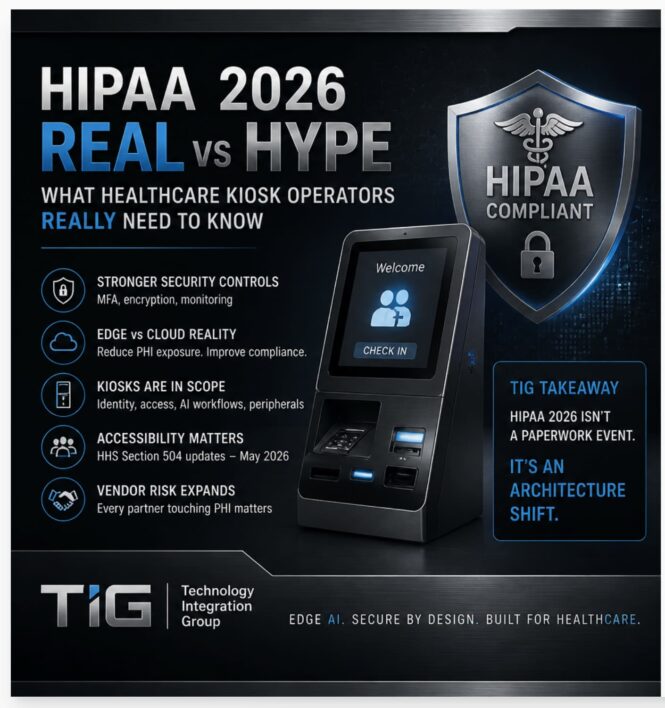
What the Industry Is Saying — and What Healthcare Kiosk Operators Actually Need to Do
Overview
A recent sponsored article on HIPAA 2026 [Healthcare Dive] changes highlights real momentum around stronger cybersecurity—but like most vendor-driven guidance, it overstates urgency and understates operational reality. It is sponsored of course.
Bottom line:
HIPAA is tightening. But the real risk isn’t “missing a checkbox.”
It’s how PHI is processed across kiosks, edge devices, and AI workflows.
The Trigger: Cybersecurity Is Driving Change
The push behind HIPAA updates is simple:
- Ransomware attacks are up
- Healthcare is a top breach target
- Legacy systems are everywhere
Regulators are responding by moving HIPAA from flexible guidance → enforceable controls
REAL vs HYPE
🔴 HYPE: “Major HIPAA changes hit in 2026 — act now or you’re non-compliant”
REALITY:
Most changes are still proposed, not finalized.
- Final rule expected: ~2026 timeframe
- Actual compliance deadlines: often 12–24 months later
- HIPAA rules aren’t set by vendors or industry groups—they’re written and enforced by HHS (through OCR) using the federal rulemaking process.
-
HIPAA rules follow the federal rulemaking process:
- Law passed by Congress
- Health Insurance Portability and Accountability Act (HIPAA) provides the foundation
- HHS proposes rules
- Published as a Notice of Proposed Rulemaking (NPRM)
- Public comment period
- Industry, vendors, hospitals weigh in
- Final rule issued by HHS
- Becomes enforceable regulation
- Law passed by Congress
-
👉 You have time—but not unlimited time.
🔴 HYPE: “HIPAA 2026 is one big unified update”
REALITY:
There are multiple parallel tracks, not one rule:
- Security Rule overhaul (cybersecurity)
- Privacy Rule updates (patient access timelines)
- CMS admin simplification rules
👉 Treating this as one project = planning failure
🔴 HYPE: “Compliance is mainly policies, audits, and documentation”
REALITY:
The shift is toward technical enforcement
Expect requirements around:
- Multi-factor authentication (MFA)
- Encryption everywhere (at rest + in transit)
- Continuous monitoring and logging
- Formalized risk analysis
👉 This is engineering + architecture, not paperwork
🔴 HYPE: “Cloud-based solutions simplify HIPAA compliance”
REALITY (critical for kiosks):
Cloud increases PHI exposure surface
Key risks:
- AI models processing PHI off-device
- API leakage / logging exposure
- Third-party vendor chain risk
👉 For patient kiosks, this is the core issue.
🔴 HYPE: “Just upgrade your systems”
REALITY:
Healthcare runs on long lifecycle infrastructure
Typical environment:
- 5–7 year kiosk deployments
- Legacy OS versions
- Peripheral dependencies (printers, scanners, payments)
👉 “Rip and replace” is rarely viable
👉 Retrofit strategy becomes essential
What This Means for Patient Kiosks
1) Edge AI becomes a compliance strategy—not just a performance choice
Processing PHI locally:
- Reduces exposure
- Simplifies compliance boundaries
- Improves reliability
👉 This is the Edge AI vs Cloud AI divide in healthcare
2) Identity and access become front-and-center
Expect tightening around:
- Patient authentication workflows
- Staff/service access to devices
- Session management on shared kiosks
👉 Kiosks are no longer “dumb endpoints”
3) Accessibility intersects with compliance
With HHS Section 504 updates (May 2026):
- Accessible interfaces are no longer optional
- Audio, tactile, and assistive workflows matter
👉 Compliance = security + accessibility
4) Business associate risk expands
Every vendor in the kiosk stack matters:
- Software platforms
- AI providers
- Device management tools
- Payment and ID verification
👉 Your vendor list = your risk surface
Perspective: Why This Matters Now
With the Kiosk Manufacturer Association (KMA) expanding its accessibility leadership—including the recent appointment of Matthijs Verhagen as Co-Chair of the Accessibility Committee—the focus is shifting from theory to deployment reality.
Key priorities emerging:
- Standardized accessibility + security design
- Device-level compliance frameworks
- Practical retrofit pathways for existing deployments
👉 This is where industry guidance is heading—not vendor checklists
Practical Next Steps (Operator Checklist)
Instead of reacting to hype, do this:
✔ Audit your PHI flow
- Where is data processed?
- Edge vs cloud vs hybrid
✔ Inventory kiosk infrastructure
- OS versions
- Compute capability
- Peripheral dependencies
✔ Map vendor exposure
- Who touches PHI?
- Where are contracts weak?
✔ Evaluate retrofit vs replace
- Can existing kiosks support:
- MFA
- encryption
- local AI inference
✔ Stress-test workflows
- Patient check-in
- ID verification
- Accessibility interaction
TIG Takeaway
HIPAA 2026 is not a paperwork event.
It’s an architecture shift.
The winners won’t be the most “compliant” on paper—
they’ll be the ones who redesign how PHI moves through their systems.
For kiosks, that means:
- Edge-first thinking
- Lifecycle-aware upgrades
- Accessibility built in—not added later