
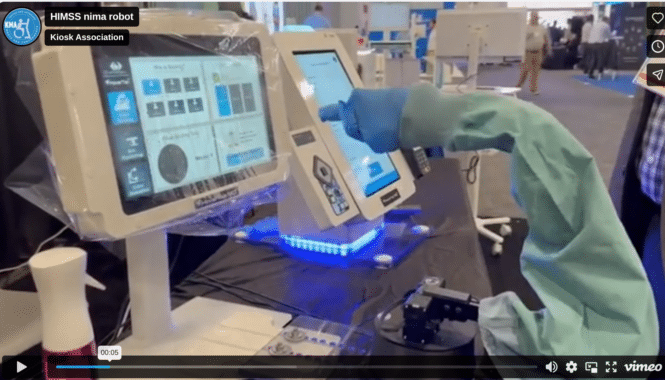
Editor’s Note: Our feature image highlights touchless gesture interaction demonstrated at HIMSS 2026—one of several biometric and assistive interfaces reshaping the hospital digital front door. For dedicated hardware profiles on Epic Welcome check-in terminals, see our Epic Welcome Kiosk Overview and Patient Check-In Kiosk Models directory.
Healthcare organizations continue to expand self-service patient check-in across hospital lobbies, outpatient clinics, emergency departments, and ambulatory surgery centers. Modern patient check-in kiosks automate routine registration, insurance verification, consent signatures, and copay collection—shortening lobby wait times and freeing front-desk staff to focus on direct patient support.
As major electronic health record (EHR) platforms like Epic integrate mobile pre-check-in, biometric authentication, and AI-assisted intake workflows, self-service kiosks serve as the physical anchor of the hospital digital front door.
Latest Patient Check-In News & Analysis
- HIPAA and Local AI – US and Global ConsiderationsHIPAA does not require local AI on healthcare kiosks. Cloud AI can process PHI with a ...
- RHTP Funding for Rural HealthcareTimely post by Olea Kiosks on RHTP — we like kiosks but CMS explicitly frames ...
- HIPAA 2026: Real vs HypeWhat the Industry Is Saying — and What Healthcare Kiosk Operators Actually Need to Do Overview A ...
- Medical Diagnosis in Metro Station – In ShanghaiImagine walking into a metro station, stepping into a booth and walking out four minutes ...
- HIMSS Demo – Robot Teaching AI Gesture RecognitionTouchless interaction in healthcare What if a robot could help train an AI to understand human ...
- Best EHR For Small PracticeWhich EHR for Small Practice For small primary care practices (roughly 1–10 providers), common “short list” ...
- HIMSS 2026: The “Digital Front Door” Survival GuideHealthcare Digital Front Door First Alerts — info good to know today — Compliance: ADA, Section 504 ...
Epic Welcome & Digital Front-Door Trends
Health systems standardizing on Epic Welcome and integrated patient intake platforms are moving beyond basic appointment arrival toward end-to-end automated registration:
- Unified Patient Portals (MyChart Central): Patients can authenticate across participating provider MyChart portals with a single set of credentials and update demographics once, reducing duplicate intake records and registration errors.
- Mobile-to-Kiosk Continuity: Patients who begin pre-visit registration on a smartphone can finish badge printing, ID scanning, or copay transactions at an on-site kiosk without re-entering data.
- AI-Assisted Intake & Scheduling: Conversational assistants (such as Epic’s Emmie within MyChart) and automated SMS scheduling tools streamline appointment booking, pre-visit screening, and patient Q&A before arrival.
- Touchless & Biometric Authentication: Palm-vein, facial recognition, and touchless gesture interfaces—alongside 2D mobile barcode scanning—speed up identity verification while minimizing shared surface contact.
- Measurable Front-Desk ROI: Hospitals deploying self-service check-in consistently report shorter registration queues, cleaner insurance capture, and higher patient satisfaction scores compared with clipboard-based intake.
Why Healthcare Facilities Deploy Patient Check-In Kiosks
Across emergency departments, specialty clinics, and multi-hospital networks, self-service check-in terminals improve both operational throughput and data accuracy:
- Faster Arrival & Triage Flow: Patients confirm appointments, update demographic changes, and notify clinical staff of their arrival in under two minutes.
- Insurance & Identity Capture: Integrated duplex ID/insurance card scanners and optical character recognition (OCR) populate EHR fields directly, cutting claim denials caused by manual keying errors.
- Point-of-Service Copay Collection: PCI-compliant EMV payment terminals allow patients to settle copays or outstanding balances privately during check-in.
- Digital Consent & Wayfinding: Electronic signature pads capture HIPAA acknowledgments and treatment consents while printing receipts, wristbands, or step-by-step clinic directions.
- Specialized Care Environments: Beyond hospital lobbies, healthcare kiosks support medication education in senior living communities, behavioral health screening, and private telehealth consultations.
Epic Welcome Hardware & Peripheral Requirements
Selecting hardware for an Epic Welcome or EHR-integrated deployment requires matching industrial-grade peripherals to clinical lobby workflows:
- Compute & OS Platform: Commercial-grade Windows or Android mini-PCs engineered for 24/7 duty cycles, remote device management, and secure browser lockdown.
- Barcode & QR Scanners: Omnidirectional 2D imagers positioned for effortless scanning of MyChart mobile passes and printed appointment reminders.
- ID & Insurance Card Readers: Duplex document scanners capable of capturing driver’s licenses and insurance cards cleanly without jamming.
- Encrypted Payment Devices: Certified PCI PTS / EMV tap, dip, and swipe terminals mounted within ADA reach ranges.
- Thermal Printers & Wristband Dispensers: Reliable, high-capacity printers for patient routing slips, receipts, or barcoded wristbands.
- Antimicrobial & Sanitization Options: Medical-grade enclosures designed for frequent hospital-grade wipe-downs or automated UV-C touchscreen sanitization.
ADA, HHS Section 504 & Healthcare Accessibility
Healthcare self-service terminals must be usable by patients with mobility, vision, hearing, and cognitive disabilities under the Americans with Disabilities Act (ADA), HHS Section 504, and Section 508 standards.
Leading kiosk manufacturers address universal access through both mechanical and assistive design. Olea Kiosks’ Austin series, for example, offers an ADA height-adjustable pedestal that moves 12 inches at the push of a button—keeping the touchscreen, scanner, payment terminal, and optional printer within compliant wheelchair reach ranges—alongside an automated industrial UV-C touchscreen sanitization system.
Comprehensive healthcare accessibility configurations also incorporate:
- Tactile keypads (such as Storm Interface navigation modules) and screen-reader audio output via private headphone jacks.
- High-contrast UI modes, adjustable font scaling, and multilingual voice or on-screen guidance.
- Unobstructed clear floor space and compliant forward/side reach tolerances for every interactive peripheral.
- Disability Inclusion in Self-Service & Workplace Design
- Regulatory News: ADA Kiosk, POS & Accessibility Standards Update
HIPAA, Patient Privacy & Local AI at Check-In
Because check-in kiosks handle protected health information (PHI) in public waiting areas, privacy architecture is critical. Physical privacy filters, automatic session timeouts, encrypted EHR transmission, and zero local PHI retention protect patient records between sessions.
As hospitals introduce voice recognition, real-time translation, and conversational assistance at check-in, many IT teams are evaluating on-premises edge AI servers versus cloud AI services to tighten control over patient audio and transcripts. For a deeper technical breakdown, read our 2026 Healthcare Kiosks, Local AI & HIPAA Briefing and Critical Privacy Considerations for Public Kiosks.
2026 Healthcare Kiosk & Epic Welcome Resources: Evaluating kiosk hardware, accessibility compliance, or local AI architectures for your health system? Contact Editor Craig Allen Keefner at info@patientkiosk.io or explore vendor specifications in our Healthcare Kiosk Models Directory.